This is a blog meant for the use of individuals and families which contains Family Home Evening lesson ideas and plans for the 2019-2020 "Come Follow Me" curriculum. This is meant to supplement the resource "Come Follow Me: For Individuals and Families". This is not an official page of the Church of Jesus Christ of Latter Day Saints.

Monday, May 2, 2022

Lesson 23: Judges 2-4; 6-8; 13-16

 May 30- June 5
Judges 2-4; 6-8; 13-16
"The Lord Requires Up a Deliverer"

Materials: video, printouts (below), scissors, pen, tape or glue
Opening Song: "Redeemer of Israel" (Hymns, 6)
Opening Prayer:

Attention Activity: Have your family do some basic exercises like jumping jacks, arm circles, sit ups, push ups etc. Why do people exercise? We should exercise to improve our physical health and strength. 

Lesson:

In the book of Judges, we read about a man blessed by God to have great physical strength. His name was Samson. Read Judges 13: 5. God blessed Samson with strength so he could help fight the Philistines, the enemy of the Israelites at the time. Samson's strength was legendary. No chains could hold him and he could lift heavy loads, but it came with a catch. Samson had to keep a covenant he made with God--he lived as a Nazarite. He could not cut his hair, could not drink any alcohol, or eat unclean meat.


Samson's strength helped to fight against the Philistines in many battles. The Philistines saw Samson as a threat and devised a way to defeat him. 

Watch "Samson and Delilah" from youtube. 


What did the Philistines do to defeat Samson? Delilah badgered Samson endlessly, saying that if Samson truly loved her, he would tell her the secret to his strength. After he was captured, Samson was taken to prison. The Philistines then tied him up between two pillars while they partied and worshipped idols. Have your family take turns reading Judges 16: 28-31

Samson's strength came from him keeping his covenants as a Nazarite. When he broke that covenant, his strength was taken from him. He later, prayed pleading with the Lord to remember him and restore his strength for one final time. The Lord answered Samson's prayers. 

Samson's story reminds us that there is strength and blessings given to us when we keep our covenants with God. Samson had physical strength, but we can have spiritual strength as we keep our covenants. 

Activity:

Directions: Before FHE print out the two pages below. Cut out the dumbbells. Ask your family: How can we be spiritually stronger? What are some spiritual exercises we can do? As your family comes up with spiritual exercises (i.e. reading scriptures, saying prayers, etc.) Tape or glue the dumbbells to bodybuilder picture. 


Keeping our covenants makes us stronger. As we keep our covenants, the Lord blesses us with strength to overcome our challenges. As we do spiritual exercises like reading our scriptures and having daily prayer, our spiritual strength is increased and we are then better able to withstand temptation and have the spiritual strength the combat Satan. 

Bear your testimony of your covenants. 

Closing Song: "Choose the Right" (Hymns, 239)
Closing Prayer:
Refreshment:

Sunday, April 24, 2022

Lesson 22: Joshua 1-8; 23-24

May 23-29
Joshua 1-8; 23-24
"Be Strong and of a Good Courage"

Materials: cowardly lion picture, video (link below), coloring utensils, badge of honor coloring page printed
Opening Song: "Faith" (Children's Songbook, 96)
Opening Prayer:

Attention Activity:

Show the picture below. Explain that this is the Cowardly Lion from The Wizard of Oz. In the movie, the lion feels like a bad lion because he is often afraid.  "He does not understand that courage means acting in the face of fear, which he does frequently. The cowardly lion is in fact brave, but he doubts himself. In many scenes in this classic book and film, the Lion shows bravery in the face of danger" ("Cowardly Lion," Wikipedia April 2022). 


Lesson:

In the Old Testament, the Lord tells the prophet Joshua, "Be strong and of good courage" (Joshua 1:6). 

Have you family watch the video "Joshua the Prophet" video from the church website.

The Israelites were led to the promised land, but there were wicked people living there. How did Joshua and the Israelites show courage in the face of this challenge? 

Courage and bravery can often relate to our faith in Jesus Christ. As we put our faith in the Lord, we are able to act in the face of our fear and do what He wants us to do. Having strength can come from the Lord too. Being spiritually strong can help us as we overcome obstacles and face down the walls of Jericho in our own lives.

There are some aspects or challenges in our life that may seem scary or daunting like the walls of Jericho were to the Israelites. What are some things that scare you? How can you have more corsage to overcome these challenges?

Activity: Badge of Courage Coloring

(Before FHE, print the page below and give one to each family member.)

At the end of The Wizard of Oz, the Cowardly Lion is given a medal to remind him of all the times he was courageous while helping Dorothy. Medals of bravery are still given to courageous men and women throughout the world by sovereigns. Color the picture below and write down one thing you will do to show more courage and faith in Jesus Christ. 


As we confront our challenges with our spiritual strength, showing corsage, and exercising faith in the Lord, He will help us to conquer those battles. When the Lord helps us overcome and conquer our trials we can remember how he has helped us and promise to follow him. As Joshua said, "as for me and my house, we will serve the Lord" (Joshua 24:15).


Closing Song: "I Will be Valiant" (Children's Songbook, 162)
Closing Prayer:
Refreshment: Apple cheesecake "tacos" recipe here 


Sunday, March 27, 2022

Lesson 21: Deuteronomy 6-8; 15; 18; 29-30; 34

May 16-22
Deuteronomy 6-8; 15; 18; 29-30; 34
"Beware Lest Thou Forget the Lord"

Materials: Remember picture (below), Remember cards printed onto cardstock, scissors, paper, and pencils
Opening Song: "Where Love Is" (Children's Songbook, 138)
Opening Prayer:

Attention Activity: Show the picture below. Have your family members read some of the ways people around the world say the word "Remember." Remember is a word used a lot in the scriptures and in our covenants. What did we promise to remember when we were baptized?

Lesson

At this time, the Israelites were approaching their final destination in the promised land. Moses  felt his life and ministry were coming to a close. He wanted to impress upon his people the importance of remembering all that had happened to the them in Egypt and for the last forty years. 

As they had journeyed in the wilderness, they had to endure many trials. Many of these trials came as a result of not living righteously. Hence, a journey that should have only taken the Israelites a few months, lasted for forty years. The Lord wanted to make sure their hearts were ready to come to the promised land. 

Moses was afraid that when the Israelites finally settled down in Judea, they would get too comfortable, forget the Lord, and harden their hearts. The final teachings of Moses focused on loving the Lord with all your heart and remembering the Lord. 

Activity: Remember Cards

Directions: Before FHE, print onto card stock and cut out the cards below and place them face down in front of your family. Have each family member take turns reading each card. Then, have each family member choose a card. 


Elder Soares said, "There is a strong correlation between the emotion felt and the resulting memory. Thus, the stronger the emotion, the more vivid and influential is the memory. In the Hebrew context, the word remember involves a knowledge that is accompanied by appropriate action. Thus, doing is an essential part of remembering" ("Always Remember Him," Liahona April 2022). 

Give each family member a piece of paper and a pencil. Have them write down what they are doing to remember Jesus. Look back at the card you picked. This week what will you do to remember what is on your card? Please place your card in your room somewhere where you can see it as a reminder of all of the good that the Lord has done for you.

Bear your testimony of the importance of remembering the Lord and keeping your baptismal covenant. 

Closing Song: "If I Listen With My Heart" (Additional Songs for Children, Gospel Music App)
Closing Prayer:
Refreshment: Boston Cream Poke Cake recipe here


Monday, March 21, 2022

Lesson 20: Numbers 11-14; 20-24

May 9-15
Numbers 11-14; 20-24
"Rebel Not Ye Against the Lord, Neither Fear"

Materials: doctor tools picture, "Moses and the Brass Serpent" video (link below), 
Opening Song: "Faith" (Children's Songbook, 96)
Opening Prayer:

Attention Activity: Show the picture below. What kind of person uses tools like these in their job? What do doctors do? Doctors help people feel better when they are sick or injured. Doctors or physicians are sometimes called healers because they help heal people when they feel unwell. Did you know that one of the some the nicknames for Jesus are "The Great Physician" and the "Master Healer?" How is Jesus like a doctor?


Lesson:

Show the video, "Moses and the Brass Serpent" from churchofjesuschrist.org (1:02)

The Israelites needed healing both physical and spiritual. They had forgotten the Lord, and when they encountered serpents on their journey, they were bitten. When this trial happened, they remembered the Lord and asked for His help to heal them from their wounds. The Lord did not immediately heal them, instead he made a test of faith. His prophet, Moses, held up a brass serpent on a staff. They had to act in order to be healed. They had to look and the staff and have faith in order for the Lord to heal them. "If they would but look up at the serpent and exercise faith in the words of Moses, they would be healed. In the same way, a person who will look up to Christ and his atoning sacrifice, as culminated on the cross, and will exercise faith in Christ will be healed" ("Is it true that the Brazen Serpent lifted up by Moses in the wilderness symbolized Christ? Why would the image of a serpent be used to represent the Savior?" Phillip F. Low, Ensign Sept. 19830). 

Activity: Look and Live Song

Play the song "Look and Live" by Katherine Nelson (EFY 2003 album). Display the lyrics below so  your family can follow along with the song.


"Look and Live"

By Katherine Nelson


Just as sure as there are stars out in the heavens tonight,

There is a hope that hovers over those looking for the light.

And though it’s just as certain as the faith in those who give,

Attention undivided they look and live.


We have wandered in the wilderness,

Long enough to know,

That there are passions filled with poisons,

Where the faith will never go.

But are fighting to stay focused,

To keep them safe within.

A promise of protection,

They look and live.


Look and live!

Feel the power of the healing,

That only He can give.

We look and live,

Forever facing forward,

To the God of all that is,

Who can live.


He’s the future in our footsteps, 

The anchor in our lives.

He’s the rock of our salvation,

In shadow and sunshine.

May He ever smile upon us,

As we find our strength in Him.

Let us heed His servants’ voices.

We’ll look and live.


Look and live!

Feel the power and the healing,

That only He can give.

We’ll look and live,

Forever facing forward,

To the God of all that is.

Look and live.


Look and live!

Feel the power and the healing,

That only He can give.

We’ll look and live,

Forever facing forward, 

To the God of all that is.

Look and live.


In the song, it talks about how we can "look and live." We might not all be bitten by snakes in our lives, but we all need spiritual healing. How can we be healed by the Savior? President Nelson gave a talk called "Jesus Christ--the Master Healer." In this talk he said, "The sequence of His pattern is significant. Faith, repentance, baptism, a testimony, and enduring conversion lead to the healing power of the Lord" (Ensign November 2005). President Nelson assures we can reach out to the Lord and ask Him to heal us through priesthood blessings and the power of prayer. How has the Savior helped to heal you? 

He ended his talk saying, "The gift of resurrection is the Lord’s consummate act of healing. Thanks to Him, each body will be restored to its proper and perfect frame. Thanks to Him, no condition is hopeless. Thanks to Him, brighter days are ahead, both here and hereafter. Real joy awaits each of us—on the other side of sorrow." 

Optional Activity: Use clay, brass colored art paint, and popsicle sticks to make your own brazen serpent. Write on the staff with a permanent maker, "Look and Live."

Bear your testimony of the healing power of the atonement.

Closing Song: "Jesus the very thought of thee" (Hymns, 141)
Closing Prayer:
Refreshment: Lemon Blueberry Bread recipe here 

Saturday, March 19, 2022

Lesson 19: Exodus 35-40; Levitcus 1; 16; 19

 May 2-8
Exodus 35-40; Levitcus 1; 16; 19
"Holiness to thee Lord"

Materials: Temple Matching worksheet, "The Tabernacle" video, The Ancient Tabernacle picture
Opening Song: "I Love to See the Temple" (Children's Songbook, 95)
Opening Prayer:


Attention Activity: Give everyone a copy of the worksheet below. Have them match the item in the tabernacle to it's spiritual significance listed. (The answers will be given in the video we will watch later)


Lesson:

The Lord often gives His children holy place where they can go to feel close to Him and have spiritual experiences. Abraham and the patriarchs had beersheba, and we have the temple. But the Israelites were traveling in a desert for forty years. They couldn't build any buildings or keep coming back to the same spot every time they needed spiritual guidance so, the Lord instructed them make a portable holy place called the tabernacle. 

Watch the video, "The Tabernacle" from churchofjesuschrist.org. 

What was the tabernacle used for? What were the 3 parts of the tabernacle called? (The outer courtyard, the holy place, and the holy of holies) What do these 3 parts of the tabernacle represent? (the celestial, terrestrial, and celestial kingdoms) Show the picture The Ancient Tabernacle, by Bradley Clark located in Come Follow Me For Individuals and Families 2022 (page 84). 


The tabernacle of the ancient Israelites has some differences from the temples we attend today. We no longer offer animal sacrifices as a way to repent of our sins for example. There are also a lot of similarities between the tabernacle and our modern day temples. What are some similarities you noticed?

Why do you think we need temples and tabernacles? The Lord told the Israelites, "Ye shall be holy: for I the Lord your God am holy" (Lev. 19:2) On the outside of every temple is the phrase "Holiness to the Lord." What does it mean to be holy?

Sister Carol F. McConkie said, "Holiness is in the striving and the struggle to keep the commandments and to honor the covenants we have made with God. Holiness is making the choices that will keep the Holy Ghost as our guide. Holiness is setting aside our natural tendencies and becoming 'a saint through the atonement of Christ the Lord.'Every moment of [our lives] must be holiness to the Lord” ("The Beauty of Holiness" Ensign, May 2017).

Just like the ancient Israelites, we are tasked to become more holy. This means being righteous, reverent, and christlike. Attending the temple helps connect our hearts to heaven and keeping the commandments shows our Heavenly Father our effort to become more holy like He is. Think of one thing you can do this week to focus on your personal holiness. How can you be more holy?

Bear your testimony.

Closing Song: "More Holiness Give Me" (Hymns, 131)
Closing Prayer:
Refreshment: Reese's Peanut Butter Ball recipe here 

Thursday, March 10, 2022

Lesson 18: Exodus 24; 31-34


 April 25- May 1
Exodus 24: 31-34
"My Presence Shall Go With Thee"

Materials: printout, video, paper, crayons, pencils
Opening Song: "I will walk with Jesus" (Gospel Library App, Additional Songs for Children)
Opening Prayer:

Attention Activity: Give each family member a piece and pencil. Write down 5 things that are really important to you. Then ask them to number them 1-5 from most important to least important. Things that are important to you are priorities. Hopefully, you put your priorities in the right order. Really important priorities could have to do with our relationships with others. Heavenly Father wants our relationship with Him to be our top priority. Our testimony of the gospel should be number 1. 

Lesson:

When the Israelites were wandering in the desert, they did not have good priorities. The Lord had saved them from slavery, but they were used to worshipping idols, not Heavenly Father. 

Have your family watch the video Moses on Mount Sinai from churchofjesuschrist.org

What did the Israelites do when Moses was on Mount Sinai? How did Moses react to the golden calf statue? Heavenly Father had already revealed the 10 commandments to the Israelites, including the commandments, "Thou shalt have no other gods before me," and, "Thou shalt not make unto thee any graven image" (Exodus 20:3-4). The Israelites had broken those commandments by making and worshipping the golden calf. 

Look back at your list from the beginning of FHE. Did you put the Lord first? If not, add the Lord to the top of your list. 

Today, we tend to not worships little figures of gold or stone. In our church we don't pray to statues. Sometimes, however, we don't always put the Lord first in our lives. Moses asked the children of Israel after he saw the golden calf, "Whose on the Lord's side?" (Moses 32:26). How can we should the Lord we are on his side? Is there something in your life you are giving more time to than the Lord? How can you show the Lord that you put Him first like he asks?

Activity:

Before FHE, print the document below for each family member. On the ribbon write, "I'll put the Lord 1st by... Ask each family member to write down or draw a picture of one thing they can do to put the Lord first on the other half of the ribbon. Then they can color the medal. 


Read the quote from President Benson above and bear your testimony. 

Closing Song"Whose on the Lord's Side" (Hymns, 260)
Closing Prayer:
Refreshment: Caramel Fudge recipe here


Monday, February 28, 2022

Lesson 17: Exodus 18-20

April 18-20
Exodus 18-20
"All that the Lord hath spoken we will do"

Materials: printouts, scissors, glue, Slips of paper labeled 1-10, a bowl, a 6 sided die
Opening Song: "Keep the commandments" (Children's Songbook, 146)
Opening Prayer:

Attention Activity: Show the picture below and ask your family who is in the picture? What is Moses holding? What doe you know about the 10 commandments? 


Lesson:

After the Israelites were delivered from bondage, Moses talked with God on top of a mountain called Mount Sinai. The Lord gave Moses several instructions, but most importantly the Lord told Moses about a set of rules he wanted his children to obey. These are called the 10 Commandments. Commandments are rules that God has given us to keep us safe and make us better people. As we keep the commandments, we become the kind of people that can return to live with our Father in Heaven. 

Activity: Window Reveal and Talk

Before FHE, follow the instructions on how to make a 10 commandments printable window craft using this link. During FHE, have a family member take turns opening each window. Describe what each commandment means. 

When Christ was on the earth he taught, "...Thou shalt love the Lord thy God with all thy heart, and with all thy soul, and with all thy mindThis is the first and great commandmentAnd the second is like unto it, Thou shalt love thy neighbour as thyself" (Mathew 22:37-39). Using the window printable, point out that the first 5 commandments have to do with showing our love for God, and the second 5 have to do with showing our love for our fellow men. Christ also taught that his disciples should obey a higher law when it comes to keeping the 10 commandments. Instead of "thou shalt not kill," he wants his disciples to not have hate in their hearts. Instead of "thou shalt not commit adultery," he said his disciples shouldn't even lust  in their thoughts. He wants his disciples to be a more celestial people. 

Activity: Roll a question

 Directions: Make 10 slips of paper, label them 1-10, and place into a bowl. Family members will take turns choosing a slip of paper that corresponds to one of the 10 commandments. Then, they will roll a 6 sided dice to determine what question they will answer about the commandment they chose. The questions are listed below

A 1-2 dice roll: How did the Savior obey this commandment?

A 3-4 dice roll: How can you obey this commandment?

A 5-6 dice roll: How does obeying this commandment strengthen our family?

Commandments are ultimately there to help us grow in celestial people. They are not restrictive, but freeing from the captivity of sin. Commandments are a blessing from Heavenly Father that enable people to show their love and devotion to the Lord and to His children.  Carol M. Stephens taught, "His laws are a manifestation of His love for us, and obedience to His laws is a expression of our love for Him" (General Conference, October 2015). 

Bear your testimony

Closing Song: "Seek the Lord early" (Children's Songbook, 108)
Closing Prayer: 
Refreshment: Churro Chocolate Lava Cakes recipe here

Wednesday, February 23, 2022

Lesson 16: Easter

April 11-17
Easter
"He will swallow up death in victory"

Materials: Easter Match Game Cards, Construction paper
Opening Song:"I Know that My Savior Loves Me" (Additional Songs for Children, Sacred Music App)
Opening Prayer:

Attention Activity: Show the video "Jesus is Resurrected" from churchofjesuschrist.org

He Lives by Simon Dewey

Lesson:

One of the special parts about reading the scriptures is that each volume of scripture testifies of Christ in its own special way. The God of the old Testament, Jehovah, is the same Jesus Christ that performed the atonement, the same Christ that appeared to the Nephites, and the same Savior that appeared to Joseph Smith in the Sacred Grove. Old Testament testifies of the coming of a Messiah. Ancient prophets like Isaiah, Zechariah, and Daniel would write about the Savior.

Activity: Old Testament Easter Match Game

Directions: Before FHE, print and cut out the cards below. Paste the cards onto construction paper or card stock that are equal in size. Shuffle the cards and place them face down in front of the family. Have family members take turns playing the match game. When they pick a card, have them read the scripture passage. There will be an Old Testament passage that prophesies about Christ's ministry and it's match will be a New Testament passage that shows a fulfillment of that prophesy.


Bear your Testimony of the Resurrection of the Savior and how the Old Testament can teach us about the Savior.

Closing Song: "Did Jesus Really Live Again?" (Children's Songbook, 64)
Closing Prayer:
Refreshment: Easter bunny coconut tails recipe here

Monday, February 21, 2022

Lesson 15: Exodus 14-17

April 4-10
Exodus 14-17
"Stand still, and see the salvation of the Lord"

Materials: bread and spreads, grab bag pictures, scriptures, prayer rock, rocks, paint, sponge brushes, permanent marker
Opening Song: "Search, ponder, and pray" (Children's Songbook, 109)
Opening Prayer:

Attention Activity: Make a bread spread platter with some different types of bread, cheese, butter, jam, or whatever you feel like and enjoy a tasty snack together. 

Lesson: 

Show the video "Daily Bread: Pattern" from churchofjesuschrist.org. 

The Israelites needed food but because they were traveling in the wilderness, they couldn't plant crops and meat was scarce. The Lord said he would provide bread that would rain from heaven. Read Exodus 16: 14-16. Collecting manna became a daily exercise for the Israelites. They had to collect it every morning because if they left it out, it would get worms in it and start to stink. Before the sabbath they would gather and bake enough bread for 2 days. 


When Christ taught the people to pray during the Sermon on the Mount, he used the phrase, "Give us this day our daily bread." What do you think he meant? Just like we have to eat food and drink water every day for physical nourishment, we also need to have daily spiritual nourishment. How can we feed our spirits?

Activity: daily bread grab bag

Before FHE  put the items listed below into a bag. Have family members take turns taking things out of the bag and answering how that brings us daily spiritual nourishment.  

Daily Bread Grab Bag: scriptures; a prayer rock or picture of  individual prayer; family prayer picture, temple picture (keeping covenants, wearing garments, family history, etc.), a heart (showing love), a picture of service, sacrament picture , listening/reading General Conference talks 

Activity: Prayer Rocks

Give each family member a rock and have them paint it with their favorite color. When the paint is dry, write "Prayer" on it with permanent marker. Tell them to stick it under their pillow as a reminder to not forget their daily prayers. 

Just like the Israelites needed to gather their daily bread to survive in the harsh wilderness, we need daily spiritual nourishment to survive in a wicked world. Daily scripture study and prayer connects us to the Savior and helps us to heed promptings from the Holy Ghost. It helps us to be better versions of ourselves and keeps us on the covenant path. Bear your testimony.

Closing Song: "Scripture Power" (Additional Songs for Children, Sacred Music App)
Closing Prayer:
Refreshment: Cheesy pull-apart garlic bread recipe here

Sunday, February 20, 2022

Lesson 14: Exodus 7-13

March 28- April 3
Exodus 7-13
"Remember this day, in which ye shame out from Egypt"

Materials: paper and crayons, construction paper, scissors, printout (see below), video clip (link below), fresh parsley, pita bread 
Opening Song: "Tis' Sweet to Sing the Matchless Love" (Hymns, 177)
Opening Prayer:


Attention Activity: Have family members draw a picture of a nightmare and a hero that could save the day. 

Lesson:

Moses had been called by the Lord to ask Pharaoh to free the Hebrews from slavery, but Pharaoh refused. The Lord was not happy with Pharaoh; he said, "For I will at this time send all my plagues upon thine heart, and upon thy servant, and upon thy people; that thou mayest know that there is none like me in all the earth. For now I will stretch out my hand, that i may smite thee and thy people with pestilence; and thou shalt be cut off from the earth" (Exodus 9:14-15).

Activity: 10 Plagues Reveal

Directions: Print the picture below. Using construction paper, cut circles of the same size as those in the image. Tape the construction paper circles over the pictures circles and number them 1-10 accordingly. Have family members take turns taking off the circles in order. Describe each plague as you go using your own words or the passages below. 


1: Waters to Blood: The first thing the Lord did to get Pharoh's attention was to have Moses and Aaron (his brother) turn all of the streams, rivers, lakes, and ponds in Egypt to turn from water into blood. All the fish died in the water and it stunk. It lasted for 7 days. 

2: Frogs: Read Exodus 8:3 

3. Lice: The next plague to come to the Egyptians was lice. Lice are tiny bugs that live in your hair and cause you to itch. Exodus says that all the dust in Egypt was turned to lice that infested all the people and animals in Egypt. 

4. Flies: Even after the water was ruined and frogs and lice infested Egypt, Pharaoh still refused to free his Israelite slaves. So the Lord sent swarms of flies into the homes of the Egyptians. 

5. Sick Cattle: Read Exodus 9: 6-7

6. Boils: Moses took ashes and threw them in the air in front of Pharaoh. When the ashes drifted down large painful sores called boils appeared on the skins of all the Egyptians including Pharaoh's magicians.

7. Hail and Fire: Pharaoh still wouldn't listen, so the Lord sent a storm--a massive hail storm. Hail is ice that rains from the sky. Sometimes hail can be very large and dangerous like ice cubes the size of baseballs raining from the sky. Along with the hail storm, fire rained down upon the earth.

8. Locusts: Locusts came next to the Egyptians. They are big huge crickets. The Lord sent so many locusts they covered the entire land so you could not see the ground and the sky seemed dark because there were so many flying around. The locusts ate all of the crops that had not already been destroyed in the storm, so the Egyptians had absolutely no food to eat. The locusts filled the houses of the Egyptians. 

9. Darkness: For 3 days a thick darkness covered the land in Egypt. The darkness was so bad no one could see each other or light lanterns.

These plagues mainly effected the Egyptians; the Israelite slaves God protected. Moses came to Pharaoh before each plague and begged him to let the Lord's people go free, but Pharaoh hardened his heart and refused. 

10. Death of the Firstborn: Moses came to Pharaoh one last time and said, if you don't let the Israelites go, all of the firstborn children and beasts will die. But Pharaoh again didn't listen and threw Moses out. 

Activity: Watch The Prince of Egypt passover clip 


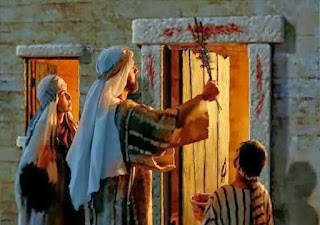
How did the Lord protect the Israelites from the plague of the firstborn? The Isrealites were told to take a lamb and use its blood to mark their doorways. The lamb would be eaten for dinner along with bitter herbs and unleavened bread. The bitter herbs (show parsley) were to remind them of the bitterness of the captivity and the unleavened bread (show pita bread) was to remind them that there was not time for their bread to rise before they fled their captivity. They had to be ready to go with their loins girded, shoes on their feet, and staff in their hand. They did this and were safe from the plague. Pharaoh, grieving the loss of all the firstborn children finally let the Israelites go. 

Every year the Jewish people celebrate the passover. The day before Jesus was crucified, he celebrated the passover meal in what we now call the Last Supper. What did Jesus do at this meal? At the Last Supper Jesus instituted the sacrament. He told the disciples to drink wine in remembrance of his blood and to eat bread in remembrance of his body. 

The passover meal and the sacrament have a lot in common. In the passover, blood of the lamb is meant to protect from death. In the sacrament, we drink water to remember the blood that was shed by Jesus, the Lamb of God. The Israelites ate the flesh of the lamb in the passover meal just like we eat the bread to help us remember the body of Christ that died for us. Read Exodus 12:14. 

Bear your testimony of the atonement and the sacrament. 

Closing Song: "He sent his son" (Children's Songbook, 34)
Closing Prayer:
Refreshment: Matzah bread recipe here

Thursday, February 10, 2022

Lesson 13: Exodus 1-6

March 21-27
Exodus 1-6
"I Have Remembered My Covenant"

Materials: mason jars or clear plastic cups, craft tissue paper (red, orange, yellow), bush cut outs, mod podge, foam brushes, battery operated tea lights, 
Opening Song: "He Sent His Son" (Children's Songbook, 34)
Opening Prayer:

Attention Activity: Guess who? 

Read the following clues below. Ask you family to raise their hand when they think they know who the mystery person might be.

  1. When I was a baby, the king tried to kill me by ordering that all the male infants in the land should be slaughtered, but I escaped thanks to my family. 
  2. I spent time in the wilderness before my ministry.
  3. I fasted for 40 days.
  4. I showed power over the waters.
  5. I was a deliverer of Israel. 
This was kind of a trick question. If you thought these things applied to Jesus Christ, you were right. But these statements also could be applied to a man who lived over 1000 years before Christ. They also apply to Moses. 

Lesson:

Moses and Jesus Christ's lives had a lot in common. Moses is what is called a "Christ type." Events the happened to Moses would later happen to Jesus Christ. Studying Moses's life the next few weeks should help us to remember the Savior. Moses is one of the most famous Old Testament persons. He is revered by both Christians and Jews as a great prophet. The book of Exodus tells Moses's story.

Have a family member summarize Moses's life up to the point where he asks Pharoh to let the Israelites go. Or you can watch the animated Old Testament stories using the links below. 

Moses received his calling to serve as God's prophet in a very unconventional way. The Lord spoke to Moses out of a bush burning with heavenly fire. He told Moses he had heard the cries of the Israelite slaves in Egypt and wanted Moses to ask Pharaoh to free his people. 
 
Activity:
Make the burning bush mason jar lanterns with your family. Instructions can be found in the link below. 


Like we talked about earlier, Moses's and Jesus's lives had lot in common. Moses acted as the Israelites deliverer out of the bonds of slavery in Egypt. Jesus Christ is likewise our deliverer. We might not be physically in slavery like the Hebrews were, but our sins can hold us in bondage. One of the names for Jesus that we use is redeemer; redeemer means to "buy back." Christ is our redeemer because he bought us back with his own blood. Christ delivers us from spiritual slavery and bondage. 

Elder D. Todd Christofferson taught, "The Savior’s suffering in Gethsemane and His agony on the cross redeem us from sin by satisfying the demands that justice has upon us. He extends mercy and pardons those who repent. The Atonement also satisfies the debt justice owes to us by healing and compensating us for any suffering we innocently endure. “For behold, he suffereth the pains of all men, yea, the pains of every living creature, both men, women, and children, who belong to the family of Adam”("Redemption," General Conference April 2013). 

Bear your testimony.

Closing Song: "I stand all amazed" (Hymns, 193)
Closing Prayer:
Refreshment: Shamrock Shake lasagna layer dessert


Thursday, February 3, 2022

Lesson 12: Gen. 42-50

 March 14-20
Genesis 42-50
"God meant it unto good"

Materials: sack, books that are labeled (see below), video
Opening Song: "Help me fear Father" (Children's Songbook, 99)
Opening Prayer:

Attention Activity: using items from around your home, make a simple obstacle course. Have each family go through the obstacle course backwards. What would have made that easier? When we only focus on what is behind us, it makes it harder to see obstacles ahead. Living in the past only hurts us. When we forgive and learn from the past, we can look ahead to the future. What does it mean to forgive? 


Lesson:

Have your family watch the video "Joseph and the Famine" from the church website. How did Joseph react to seeing his brother's again after 14 years? Did he forgive them?

Activity

"Fill a bag or sack with five heavy objects (such as books or rocks) that have each been labeled with one of the following words: revenge, hurt, hate, resentment [bitterness about being treated unfairly]and anger.  Have each family member take a turn trying to carry this heavy load. Explain that carrying those feelings in our hearts is an even greater burden than carrying the heavy bag. When we really forgive, we forget all of these feelings and are free from the burden of carrying them" (Family Home Evening Resource Book, pg. 186). 


Joseph forgave his brothers but it wasn't immediate. Sometimes it takes time and the Lord's help to soften our hearts enough to forgive people who have wronged us. When we feel hurt or wronged, we can take comfort in the fact that our Lord and Savior knows exactly how we feel. He was betrayed by one of his closest friends and then crucified by his own people. He also is the ultimate example of forgiveness, pleading on the cross, "Father, forgive them for they know not what they do." We can always pray to the Father for help to find peace and forgiveness with others in our lives. 

Closing Song: "Lord, I would follow thee" (Hymns, 220)
Closing Prayer:
Refreshment: whipped hot chocolate recipe here